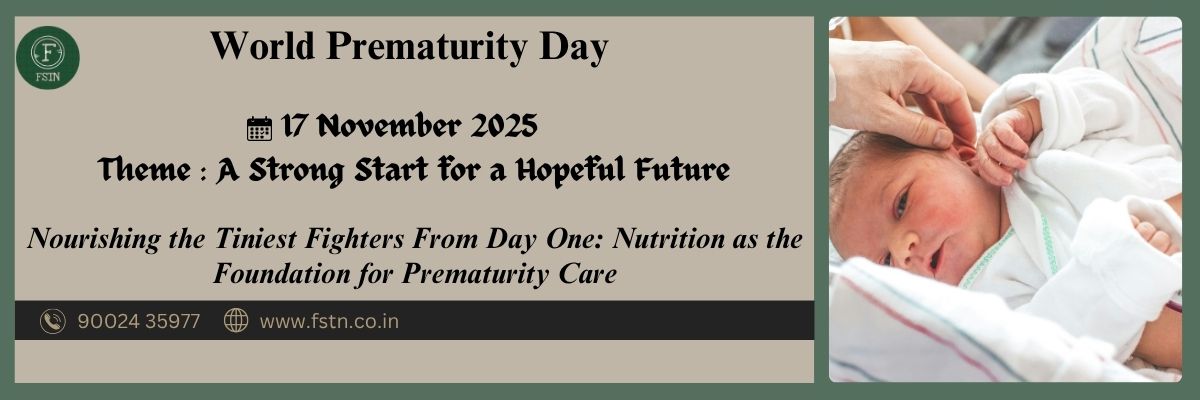
Every year on 17 November, the world observes World Prematurity Day to raise awareness about the millions of babies born too soon — before 37 weeks of gestation. In 2025, the theme “A Strong Start for a Hopeful Future” powerfully emphasizes the need for quality care, evidence-based nutrition and early developmental support to ensure that every premature and low birth weight baby not only survives but thrives.
This year, the WHO is calling on governments, health systems, and global partners to prioritize early, equitable and high-quality care for preterm infants. At the heart of this care lies paediatric nutrition — the foundation on which a premature baby’s future health, growth and neurodevelopment depend.
Why Prematurity Needs Priority Attention
Today, 1 in every 10 babies worldwide is born prematurely. Preterm birth remains a leading cause of neonatal deaths and long-term disabilities, affecting respiratory, neurological, metabolic and immune systems. These fragile infants have unique anatomical and physiological challenges: immature organs, limited nutrient reserves, and increased nutrient needs for catch-up growth.
This is precisely why early nutrition isn’t optional — it’s life-saving.
Quality Nutrition: The First Step Toward a Strong Start
Paediatric nutrition is central to the theme “A Strong Start for a Hopeful Future”, as nutritional care directly influences survival, cognitive development, bone health and long-term metabolic outcomes.
✔ Breast Milk — The Gold Standard
Breast milk is considered the best therapeutic intervention for premature infants. It provides:
- Antibodies that reduce infection and NEC risk
- Growth factors for gut maturation
- DHA and ARA for brain and retinal development
- Easy-to-digest proteins for the immature digestive system
However, as preterm babies have higher requirements, human milk fortifiers (HMF) are often essential to meet optimal protein, calcium, phosphorus, and calorie needs.
✔ Donor Milk Banks
Ensuring access to pasteurized donor human milk for mothers who cannot provide sufficient milk aligns strongly with WHO’s call for equitable, high-quality care.
Neonatal Growth: A Delicate Balance
Premature babies need to grow at a rate similar to intrauterine growth. Achieving this requires:
- Continuous nutrition monitoring
- Use of Fenton or INTERGROWTH-21st growth charts
- Assessment of weight velocity and head circumference
- Prevention of extrauterine growth restriction (EUGR)
Quality nutrition during the first 1,000 days — especially the neonatal period — reduces risks of developmental delays, feeding intolerance, metabolic diseases and stunting.
Early Feeding Practices: Bridging Survival and Development
Early feeding stands at the intersection of medical care and nutrition.
- Parenteral Nutrition (PN)
Used immediately after birth to meet energy and protein needs when enteral feeds are not yet tolerated.
- Minimal Enteral Feeding (Trophic Feeds)
Starting small, nutritionally insignificant volumes of milk—known as trophic feeds—soon after birth "primes the pump" of the immature gut. This stimulates enzyme production, promotes motility and helps establish a healthy microbiome, all while minimizing the risk of feeding-related complications.
- Gradual Feed Advancement
Feeds are slowly increased based on tolerance, promoting safer digestion and better growth.
- Transition to Oral Feeding
Mother’s Own Milk (MOM) is indisputably the best form of nourishment, offering critical immunological protection and anti-inflammatory properties that reduce the risk of Necrotising Enterocolitis (NEC). However, MOM must be fortified with commercial supplements (human milk fortifiers) to bridge the gap between the milk's natural composition and the preemie's extremely high nutrient requirements.
As the infant matures, oral feeding begins, guided by cues and suck-swallow-breathe coordination. Kangaroo Mother Care (KMC) enhances both feeding success and physiological stability. These early, aggressive, yet safe feeding protocols are designed to accelerate the infant’s transition off intravenous (parenteral) nutrition, which is a key risk factor for bloodstream infections, and move them toward full enteral feeding.
A Call to Action: For Families, Health Systems and Nations
This year’s theme urges us to create systems of care where every premature baby’s survival and quality of life improves with:
- Skilled neonatal support
- Access to breast milk and fortification
- Educating parents & Strengthening neonatal family-centered care
- Empowering nutrition professionals
- Continuous follow-up for growth and development
“A strong start” begins with nutrition — and nutrition begins with informed, compassionate care.
On this World Prematurity Day, may we reaffirm our commitment to giving every tiny life a fair, hopeful and healthy future. They grow not just to survive, but to flourish.
.